

24 Hour Gym for Professionals That Works

Your schedule does not care when the squat racks are free. Meetings run late. Flights leave early. Clients need answers at 6 a.m. and your phone still lights up at 9 p.m. That is exactly why a 24 hour gym for professionals makes sense - not as a luxury, but as a practical standard for people who take training seriously and cannot build their week around a club’s operating hours.
The problem is that not every gym with all-day access is built for serious use. Some are technically open around the clock, but the experience falls apart where it matters. Equipment is limited. Recovery is an afterthought. Programming support is generic. The environment feels like a budget workaround instead of a place designed for people with high standards and limited time.
If you are a professional who trains consistently, access alone is not enough. You need a gym that respects your time, protects your progress, and removes friction from the process.
What professionals actually need from a gym
Most busy adults are not looking for entertainment. They want a place where they can get in, train hard, and get on with their day. That changes what matters.
A good facility for this audience starts with reliability. If you plan to train at 5 a.m. before work or 10 p.m. after a long day, the gym has to feel usable at those hours. That means real equipment availability, a calm layout, and enough space to move without waiting or negotiating around people camping on machines.
It also needs to support efficiency. Professionals do not have 90 minutes to waste wandering through a packed floor, changing plans because key stations are occupied, or dealing with a chaotic environment that kills focus. They need clear access to the tools that matter - racks, free weights, cable systems, conditioning options, and recovery support that helps them come back strong the next day.
Then there is the issue most commercial gyms ignore: durability. If you are training four or five days a week while balancing a demanding career, your body has to hold up. A gym built around smarter training, not just harder training, gives you a better chance of staying consistent.
Why a 24 hour gym for professionals is different from a standard gym
The phrase sounds simple, but the difference is significant.
A standard gym is often built around volume. More memberships. More foot traffic. More classes. More noise. That model works if your priority is price or convenience in the broadest sense. It does not work well if your priority is uninterrupted training.
A true 24 hour gym for professionals is built around control. Control over your schedule. Control over your training environment. Control over the quality of your sessions.
That usually shows up in a few ways. The membership base is more selective. The atmosphere is quieter. Equipment choices reflect serious lifting and performance work instead of trends. The staff philosophy, if the gym has one worth paying for, is based on outcomes rather than sales scripts.
This is not about feeling exclusive for the sake of it. It is about removing the variables that make training inconsistent. Crowds, noise, poor layout, weak coaching, and random programming all add up. Over time, they cost you sessions, energy, and results.
The real value is not 24/7 access. It is decision-free training.
Busy people do better when the path is obvious.
When your gym is open whenever you need it, you stop negotiating with your schedule. You do not need to squeeze workouts into a narrow window or hope you can beat the after-work rush. You train when the opening exists.
But the bigger advantage is mental. Decision fatigue is real. If every workout starts with questions like, Will the gym be packed? Will I have to wait for equipment? Do I need a backup plan? then training becomes harder to sustain.
A well-run gym removes those questions. You know what the room will feel like. You know the equipment you need will be there. You know you can move efficiently. That predictability matters more than most people realize.
For professionals, consistency is rarely lost because they stopped caring. It is lost because too many small obstacles made the process harder than it should be.
Serious equipment matters more than square footage
A lot of gyms sell the idea of size. Massive floor plans. Endless machines. Walls of cardio. That sounds impressive until you realize half the equipment does not serve your goals.
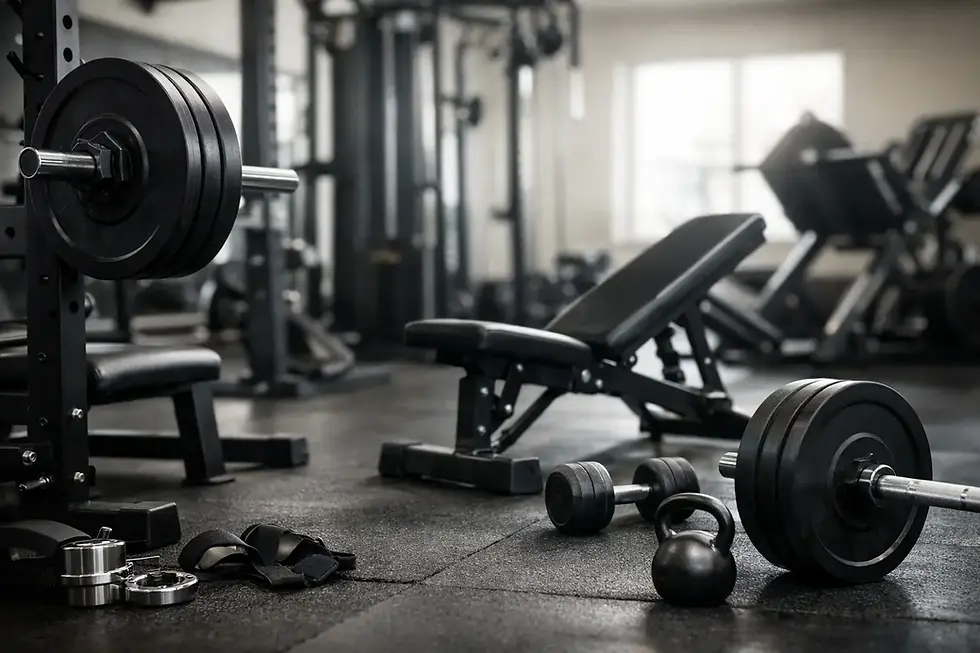
If you care about strength, body composition, longevity, and performance, the better question is whether the gym has the right tools and enough of them. Multiple quality racks. Barbells that are maintained. Dumbbells that go heavy enough. Cable stations that move well. Benches that are stable. Open space for loaded carries, mobility, or conditioning work.
This is where many commercial gyms miss the mark. They have plenty of equipment, but not enough of the equipment serious people actually use. So even in a large facility, your session gets bottlenecked.
A premium gym does not need to be oversized. It needs to be intentional. Every piece should earn its place.
Smarter training beats harder training
There is a reason high-performing adults get frustrated with typical gym culture. Too much of it is built around random effort. Exhaustion gets mistaken for progress. Pain gets treated like proof of commitment. Then people wonder why their shoulders ache, their back tightens up, or they stall after a few months.
That approach does not work if your career, family, and health all depend on staying functional.
A better model is training that is grounded in movement quality, smart loading, and recovery. That does not mean soft training. It means training with purpose.
A gym shaped by a physical therapy-informed philosophy has a clear advantage here. It tends to emphasize mechanics, tissue tolerance, progression, and sustainability. That matters if you want to keep building strength without collecting avoidable problems along the way.
This is one of the biggest differences between a cheap gym and a serious one. The cheap option gives you access. The serious option gives you a better environment for long-term progress.
No crowds is not just a comfort issue
People often talk about crowded gyms as an annoyance. For professionals, it is more than that.
Crowds slow everything down. They break concentration. They force substitutions you did not plan for. They stretch a 45-minute session into 70 minutes. If your calendar is tight, that is not a small inconvenience. It can be the difference between training and skipping it.
There is also a quality issue. A quieter, more disciplined environment usually leads to better sessions. You move with more focus. You rest with intention. You do not waste energy navigating chaos.
That is why premium, lower-traffic facilities appeal to serious members. They make it easier to execute. And execution, not motivation, is what drives results.
How to evaluate a 24 hour gym for professionals
If you are comparing options, do not get distracted by marketing language. Pay attention to how the gym will function in real life.
Start with access. Is it truly usable around the clock, or is 24/7 access just a line on the website? Then look at the training floor. Is it built for serious strength work, or mostly for casual traffic? Ask yourself whether you could complete your normal program there without compromise.
Next, consider the environment. Is it clean, calm, and organized? Does the member base seem aligned with your habits, or are you paying premium rates for a space that still feels unfocused?
Finally, look at the training philosophy. This matters more than many people think. A gym that understands recovery, progression, and injury reduction gives committed members a better return on their effort. In Scottsdale, Kinetic Fitness stands out for exactly this reason - serious access, serious equipment, and a physical therapy-informed approach that respects both performance and longevity.
The trade-off is simple. A better gym may cost more. It may also be more selective. For the right person, that is not a downside. It is the point.
Who this kind of gym is actually for
Not everyone needs this setup.
If you work out occasionally, prefer classes, or mainly want the lowest monthly rate, a standard commercial gym may be enough. There is nothing wrong with that.
But if training is part of how you operate - if you lift consistently, value structure, and want an environment that supports rather than interrupts your routine - the wrong gym becomes expensive in a different way. It costs time, focus, and momentum.
A high-quality 24/7 facility is for people who see fitness as part of their standard, not a seasonal project. People who want privacy without sacrificing performance. People who would rather pay for a better system than keep fighting a bad one.
The best gym is not the one with the loudest branding or the cheapest offer. It is the one that makes disciplined training easier to sustain when life is busy, demanding, and real.
If your schedule is full and your standards are high, that is the filter that matters.


Comments